.png)


Participating in the International Conference "UN Forum on Business and Human Rights" in Geneva and Presenting on Child Labour Free Zones
(Originally published: December 2025)
Thank you always for your continued support.
From November 24–26, 2025, three ACE staff members — Yuka Iwatsuki, Yukiko Sato, and I (Yuko Kawamura) — attended the 14th UN Forum on Business and Human Rights held in Geneva, Switzerland. This international conference brings together individuals working in this field from governments, international organizations, businesses, civil society organizations, trade unions, lawyers, and academia from around the world. This year, more than 4,650 people participated, surpassing last year's attendance.
In addition to the presentation on Ghana's Child Labour Free Zones at the Africa regional session that ACE co-hosted, we attended a variety of sessions throughout the forum, engaging with the latest discussions on business and human rights and reflecting on how they connect to ACE's various activities. We also took advantage of our time in Geneva to exchange information with various local stakeholders between sessions.

Photos from sessions and meetings:
Top: With Ghana government official Esther Ofori after the co-hosted session
Bottom left: With Antonie C. Fountain of the VOICE Network
Bottom right: With UN Special Rapporteur on Contemporary Forms of Slavery, Tomoya Obokata
Co-Hosting the Africa Regional Session and Presenting Ghana's Child Labour Free Zones
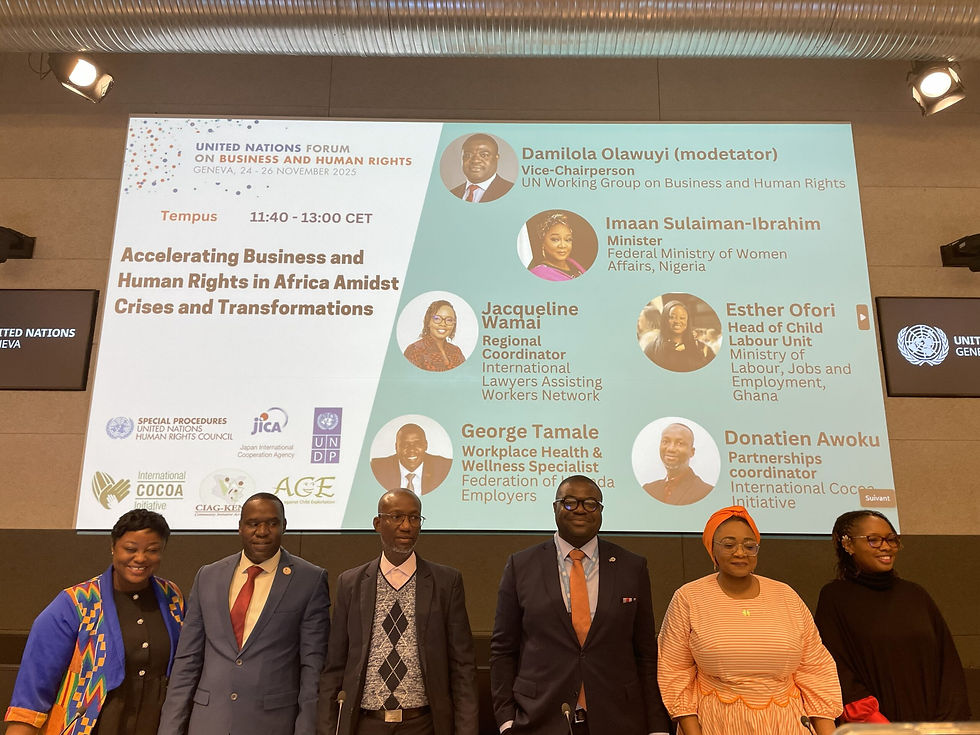
One of the key reasons for attending the forum was to serve as co-organizers of the Africa-themed session — "Accelerating Business and Human Rights in Africa Amidst Crises and Transformations" — and to communicate ACE and JICA's (Japan International Cooperation Agency) efforts on Child Labour Free Zones to the international community.
Esther Ofori, Head of the Child Labour Unit, Labour Department of the Ministry of Labour, Jobs and Employment in Ghana, who is driving the Child Labour Free Zone initiative, presented at the session, while ACE's three staff members handled preparation and on-the-day support.

Esther Ofori of the Ghana government presenting on Child Labour Free Zones
With four speakers presenting across an 80-minute session, and time reserved for floor contributions in the second half, each panelist had limited time to speak. It was easy to imagine that for those hearing about Child Labour Free Zones for the first time, a verbal explanation alone would make it difficult to grasp the full picture.
To address this, Yukiko — who is also a project staff member for the Child Labour Free Zone promotion project commissioned by JICA, in which ACE is a consortium member — prepared a dedicated leaflet for the occasion. On the day, our team spread out across the wide venue entrance to hand it out. Since some participants joined online, we also requested that the materials be posted on the session's webpage. Around 150 people gathered in the room for this session.

Yuka Iwatsuki, directing questions to panelists on two themes: the role of government and how it functions on the ground, and the role of partnerships in advancing business and human rights efforts.
Thanks in part to these team efforts, Ghanaian government has since received inquiries from people who want to learn more about Child Labour Free Zones, and we feel that this was a meaningful opportunity to raise awareness and understanding of efforts to eliminate child labour.
The session archive is available here: https://webtv.un.org/en/asset/k1h/k1hndoh8xd (from 1:43:18)
Tackling Diverse "Crises" Through Practice
At last year's forum, the key topics centered on the "smart mix" — combining international cooperation-based initiatives, voluntary corporate measures, and legally mandated approaches at the national and regional level — along with its effectiveness and challenges.
This year's forum was themed "Accelerating Business and Human Rights Amidst Crises and Transformations." Beyond the rise in human rights violations, the current reality of weakened governmental capacity to protect human rights — due to cuts in contributions from various countries to the UN and civil society organizations — was prominently highlighted.
Both governments and the business sector are facing diverse challenges, and a notable feature of this year's forum was the prevalence of more practice-based discussion throughout.
Key session themes included:
Strengthening human rights protections in digital technologies including AI and platform labour
Sharing methods for conducting human rights due diligence that ensures the safe and meaningful participation of rights-holders, taking into account the complexity of remedy mechanisms
Implementing gender-responsive human rights due diligence and ensuring the equal and meaningful participation of women human rights defenders
Methods for collecting and ensuring the quality of information for human rights due diligence in high-risk environments such as conflict and social unrest
Sharing success stories and practical models for achieving a just transition, with a focus on vulnerable groups including children, indigenous peoples, and workers in high-risk, low-governance regions
Shaping just transition policies at the national and global level taking into account regional and cultural contexts, and the role of media in that process
Threats faced by human rights defenders in specific industries such as extractives, agriculture, and renewable energy, and the establishment of stronger governance, accountability, transparency, and safe stakeholder engagement by companies
The role that certification systems and audit bodies should play in achieving effective and transformative remedy in human rights due diligence
From Geneva to Morocco — What Challenges Were Set for ACE?
At this year's forum, we had the opportunity to hear from many indigenous peoples and individuals who had been forcibly displaced. At the same time, despite child labour being identified as a high-risk human rights issue in "Business and Human Rights," there were virtually no children or young people with direct experience of child labour among the speakers. Across the three days, only a handful of sessions included children's voices.
We felt there is still much room for improvement in treating children as stakeholders in the practical work of preventing, remedying, and eliminating child labour in the context of human rights due diligence, as well as in awareness-raising efforts around this.
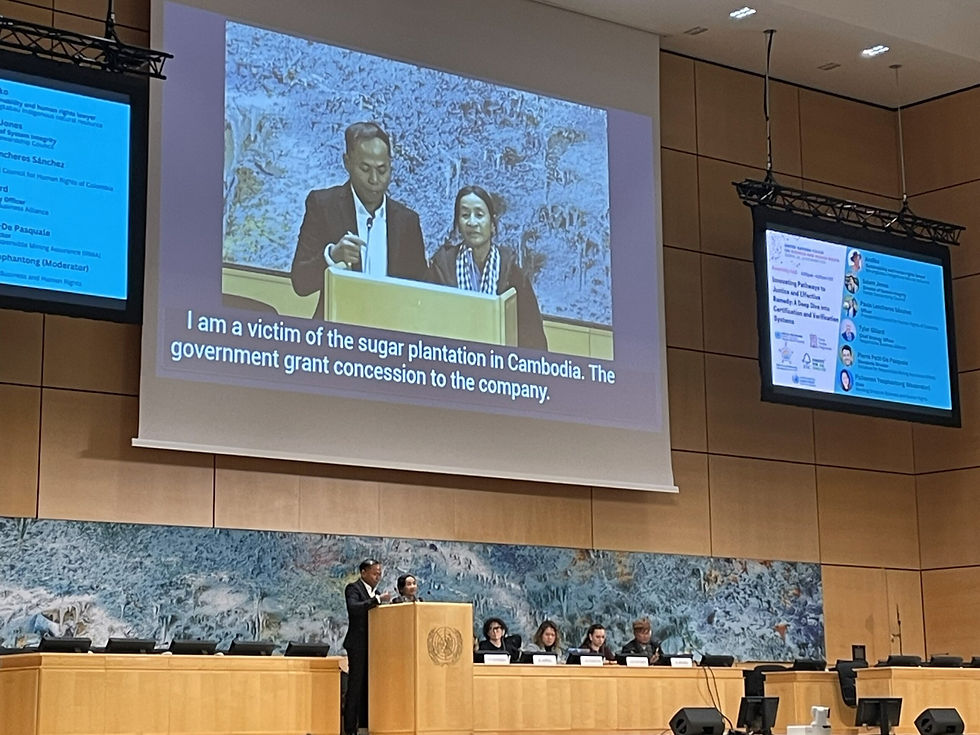
A presentation by individuals who were forced to relocate due to large-scale land acquisition in Cambodia's sugarcane industry
ACE is currently working — centered around the Global March Against Child Labour, an international advocacy network of which ACE is a member — to prepare for the 6th Global Conference of Elimination on Child Labour, to be held in Morocco in February 2026, with the aim of ensuring that the voices of children and young people with direct experience reach policymakers.
We will continue our activities, using the sense of urgency we felt in Geneva as a driving force and applying the lessons learned to our collaboration with stakeholders across ACE's various initiatives.
We would be grateful for your continued support.
Author: Yuko Kawamura, Advocacy officer

![[Upcoming Event Announcement] Side Event & Innovation Fair at 6th Global Conference on Elimination of Child Labour](https://static.wixstatic.com/media/9d5682_61d37f2c30b2400ebf6a82171d4937a5~mv2.png/v1/fill/w_980,h_1225,al_c,q_90,usm_0.66_1.00_0.01,enc_avif,quality_auto/9d5682_61d37f2c30b2400ebf6a82171d4937a5~mv2.png)
